
Your traffic is collapsing. Not necessarily because your content is weak, but because your prospects never arrive.
B2B marketers are watching their click-through rates drain while total search volume holds steady. The traffic isn’t disappearing; it is being intercepted. ChatGPT, Perplexity, and Google AI Overviews now answer user questions before anyone clicks through to your site.
This is the zero-click reality. Your ideal customers type in their query, get an AI-synthesized answer in seconds, and move on. Your carefully optimized landing page? Never seen. Your thought leadership content? Never read. Your funnel? Never entered.
The data is stark. By late 2025, a significant majority of informational searches ended without a click. Not because users couldn’t find answers, but because they already had them. The AI delivered the synthesis directly on the results page.
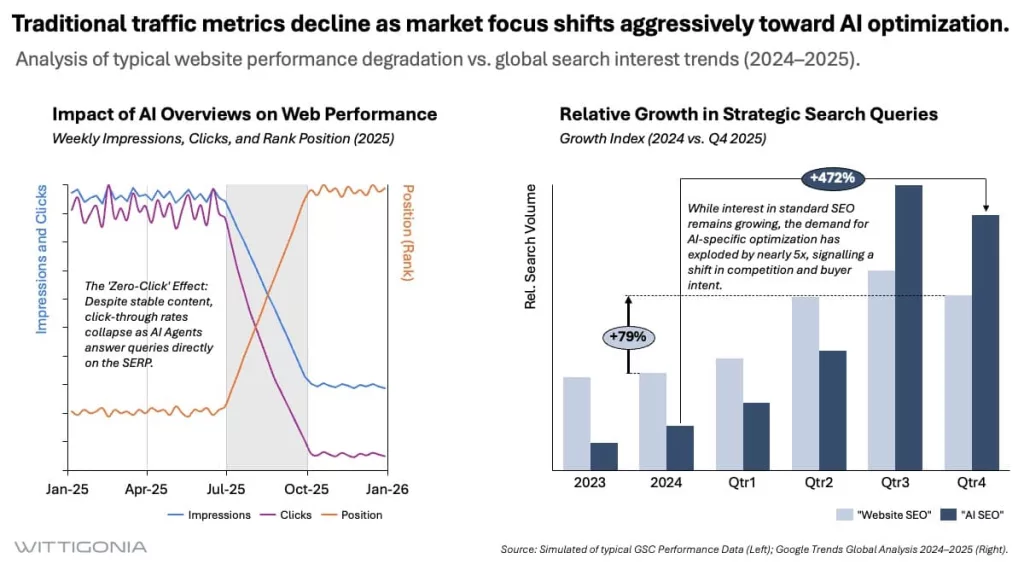
What this means: If your SEO strategy still centers on ranking 10 blue links higher, you are optimizing for a distribution channel that is actively dying.
Why Keywords Fail in the AI Era
Traditional keyword optimization assumes a human will scan results and click. But AI doesn’t scan; it synthesizes. And it doesn’t need your keywords. It needs your identity.
Here is the mechanical difference: keywords are text strings. They are fragile identifiers that carry no structural meaning. When you write “enterprise CRM solutions,” a search algorithm sees three words in proximity.
Entities, however, are distinct objects in a Knowledge Graph. They have a universal ID. They have defined relationships. To an AI, “WITTIGONIA” is not just a word; it is an Organization that HasFounder Thomas Wittig and OffersService Entity SEO. This is how AI and search engines are crawling, interpreting and prioritizing your content.
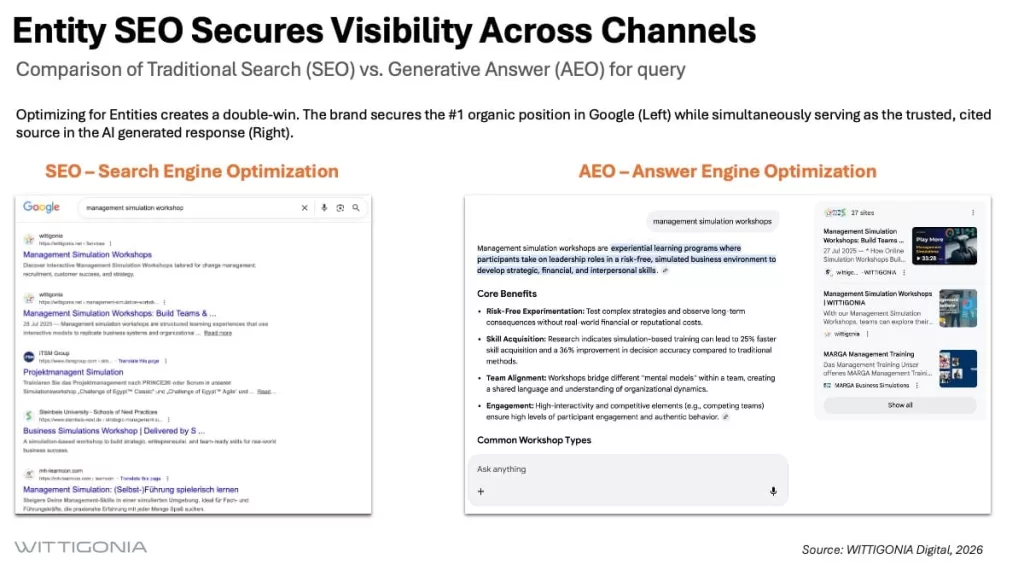
If you optimize for keywords, you are hoping the algorithm matches your text. If you optimize for Entities, you are teaching the algorithm who you are.
The Three Pillars of Visibility
To survive the shift from Search Engines (SEO) to Answer Engines (AEO), you need more than just good keywords or clean code. You need a system that satisfies both the human reader and the AI agent.
We call this the “Relevance-Entity-Delivery” framework.
1. Radical Helpfulness (The Human Signal)
AI can summarize facts, but it cannot synthesize your unique experience. If your content is generic, an LLM will summarize it and never cite you. To be cited, you must provide Information Gain—unique data, contrarian perspectives, or deep case studies that do not exist elsewhere.
- The Goal: Demonstrate E-E-A-T (Experience, Expertise, Authoritativeness, and Trustworthiness). Google and AI models privilege content that clearly comes from a human expert, not a content farm.
2. Entity Definition (The Machine Context)
Once you have the content, you must teach the machine who owns it. AI models struggle to trust sources they cannot identify.
- The Fix: We use JSON-LD Schema to wrap your content in a digital identity layer. We explicitly tell crawlers: “This is not just a blog post; it is an insight from WITTIGONIA, a consultancy founded by Thomas Wittig.” This disambiguates your brand from competitors and establishes you as a primary node in the Knowledge Graph.
3. Technical Delivery (The AI Handshake)
Finally, the infrastructure must be agent-friendly. While Google uses sitemap.xml to find your pages, the new generation of AI agents benefits from a different standard: /llm.txt.
- The Mechanism: Think of this as a “resume for robots.” It is a Markdown file that provides a distraction-free summary of your website’s core structure. Implementing it reduces the friction for an LLM to ingest and cite your content.
Related article from our WITTIGONIA Lab: How to optimize a Zoho Sites websiste for SEO and page speed.
The Mental Model Shift
You are no longer competing for position 1 on a SERP. You are competing to be the definitive source in a knowledge graph.
This also changes how you measure success. Don’t just track organic clicks. Track brand mentions in AI outputs. Monitor which pages get cited as sources in Perplexity. Audit whether your entity appears in Knowledge Panels.
If your analytics dashboard still shows “organic traffic” as the primary KPI without any citation metrics, you are measuring the old game while playing the new one.
Next Steps
Entity authority is not built overnight. It requires systematic implementation of structured data, content depth, and machine-readable protocols.
Most B2B companies are still operating on keyword-era assumptions. The ones who adapt early will dominate answer engine results while competitors remain invisible.
Ready to upgrade your system? If you need to audit your current entity visibility – whether your organization is properly defined in knowledge graphs, or whether your site is ready for AI agents – review our Entity SEO Services for classic and AI search visibility.
The zero-click era rewards depth, structure, and technical precision. Keywords got you this far. Entities will take you forward.
Related Deep Dive about WordPress versus Zoho Sites.
About the Author
Thomas Wittig CEO & Founder, WITTIGONIA
Thomas Wittig is the System Architect behind WITTIGONIA. With a background in executive leadership at Microsoft and SAP, and specialized research in System Dynamics, Thomas advises B2B leaders on engineering growth in complex digital environments. He works at the intersection of AI strategy, data intelligence, and human behavior.
Follow us on LinkedIn and YouTube for insights about SEO and AEO.